Key takeaways
- Keep a simple first-aid kit ready before you need it - sterile saline, gauze, vet wrap, a poultry-safe wound spray, Epsom salts, styptic powder, and your poultry vet's phone number.
- For minor wounds, flush with sterile saline, pat dry, and apply a poultry-safe antibacterial topical (never an ointment ending in '-caine'), checking daily for spreading redness, heat, or pus.
- Early, mild bumblefoot can respond to Epsom-salt soaks, cleaning, and soft bandaging, but a hard black scab or deep abscess needs a veterinarian to debride and prescribe antibiotics.
- Isolate any bleeding bird immediately - flockmates peck at red tissue - and reintroduce only once the wound is fully healed and feathered over.
Quick answer: For minor chicken wounds, isolate the bird, flush the area with sterile saline, gently pat dry, and apply a poultry-safe antibacterial topical, checking daily for infection. Treat early bumblefoot with Epsom-salt soaks and clean bandaging. Call a vet for deep wounds, heavy bleeding, advanced bumblefoot, infection, or a bird that is weak or off its feed.
I grew up on my family's organic farm, and if there's one thing decades of backyard keeping have taught me, it's that hens have a gift for finding trouble. A snagged wing on a fence, a squabble over a favorite nest box, a sore foot that creeps up overnight — sooner or later, every flock keeper meets a banged-up bird. I'm not a veterinarian, and nothing here replaces one, but I want to share the calm, practical routine I rely on so you can act quickly instead of panicking.
Good chicken first aid is mostly about three things: being prepared before you need to be, knowing the gentle basics of cleaning a wound, and recognizing the honest limits of home care. Let's walk through all of it, from building your kit to treating pecks and bumblefoot, isolating the patient, and preventing the next injury.
What should I keep in a chicken first-aid kit?
Keep a simple, ready-to-grab kit with sterile saline, a needleless syringe, gauze, vet wrap, blunt scissors, a “-caine”-free antibacterial ointment, a poultry-safe wound spray, Epsom salts, styptic powder, gloves, an isolation tote, and your vet's phone number. When a hen is bleeding, you do not want to be rummaging through cabinets. Assemble it now and keep it where you can grab it in the dark. Veteran keepers and poultry educators (including author Gail Damerow) agree the single most valuable item is the phone number of a vet who will see poultry — tape it right inside the lid.
- Sterile saline solution (or supplies to make your own with non-iodized salt and cooled boiled water) for flushing wounds
- A large syringe or squeeze bottle, with the needle removed, for rinsing
- Clean gauze pads, cotton rounds, and paper towels
- Self-adhesive bandage wrap (vet wrap) that flexes without restricting movement
- Blunt-tipped scissors and clean tweezers
- Plain antibacterial ointment without any “-caine” pain reliever, which can harm birds
- A poultry-safe wound and skin spray for everyday pecks and scrapes
- Epsom salts for foot soaks
- Disposable gloves and a styptic powder or cornstarch to slow minor bleeding
- A small carrier or tote that doubles as an isolation “sick bay”
- Your veterinarian's phone number and your state extension poultry contact
For day-to-day pecks and minor scrapes, I keep a bottle of Happy Cluck Poultry Wound & Skin Spray in the kit as a gentle topical recovery aid — it's an easy way to clean and support minor surface wounds between checks, though it's no substitute for veterinary care when a wound is deep or infected.
How do I treat a cut, scrape, or pecking wound on a chicken?
Restrain the hen calmly, stop any bleeding with pressure or styptic powder, flush the wound with sterile saline, trim away stuck feathers, apply a poultry-safe topical, and cover larger wounds with daily-changed gauze. Most surface injuries on a healthy hen heal beautifully with a little patience. Here's the routine I follow, drawn from how poultry-care authorities recommend handling minor wounds:
- Restrain her calmly. Wrap the bird loosely in a towel to keep her still and reduce stress. Work with another set of hands if you can.
- Stop active bleeding. Apply gentle pressure with clean gauze. For small nicks, a dab of styptic powder or cornstarch helps. Heavy bleeding that won't stop is a vet matter.
- Flush the wound. Rinse generously with sterile saline using a needleless syringe. Saline lifts out dirt and feathers without stinging or damaging tissue the way harsh disinfectants can.
- Trim and inspect. Carefully snip away feathers stuck in the wound so you can see its true depth and keep the area clean.
- Apply a topical. Pat dry, then add a thin layer of plain antibacterial ointment or a poultry-safe wound spray.
- Cover if needed. Light wounds can stay open and clean; larger ones may benefit from gauze and vet wrap that you change daily.
Check the wound every day. An infected wound tends to look red and angry at the edges, may feel hot, can ooze pus, and the scab may grow rather than shrink. If a wound hasn't clearly improved within about two weeks, treat it as infected and seek help.
| Injury type | First steps at home | See a vet if… |
|---|---|---|
| Minor cut or scrape | Flush with saline, pat dry, apply topical, monitor daily | It deepens, won't stop bleeding, or shows infection |
| Pecking wound (skin/vent) | Isolate the bird immediately, clean, apply anti-peck topical, address cause | Tissue is torn open, vent is involved, or the bird is declining |
| Deep or gaping wound | Control bleeding, keep clean and covered, transport calmly | Almost always — may need stitches or antibiotics |
| Bumblefoot (foot abscess) | Epsom-salt soak, clean, soft bandage if very early and mild | Hard black scab, swelling, lameness, or deep abscess |
| Bleeding broken feather/nail | Apply pressure and styptic powder; keep calm and clean | Bleeding persists or the area becomes infected |
What is bumblefoot and how do I treat it?
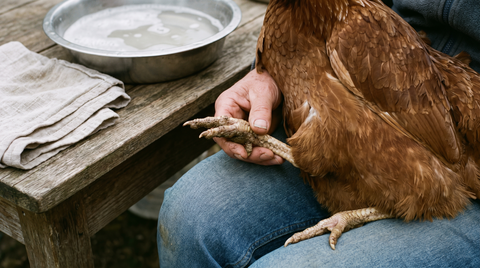
Bumblefoot is a bacterial foot abscess, usually capped by a black scab; early mild cases may respond to Epsom-salt soaks, cleaning, a poultry-safe topical, soft bandaging, and dry bedding, while advanced cases with a deep abscess need a vet. Known clinically as pododermatitis, it is one of the most common foot problems I see in backyard flocks. It typically begins when bacteria such as Staphylococcus enter through a small cut or pressure sore on the bottom of the foot, leading to a swollen, painful abscess often capped by a tell-tale black scab. Affected hens may limp, favor the foot, or be reluctant to come down from the roost.
Veterinary sources describe early, mild cases (sometimes called stage 1 to 2) as treatable with husbandry changes and supportive care: daily Epsom-salt foot soaks to soften the area, thorough cleaning, a poultry-safe topical antibacterial, soft bandaging, and clean, dry bedding to take pressure off the foot. Catching it early is everything.
Here's my honest line in the sand: once there's a firm black scab, significant swelling, or a deep abscess, that foot needs a veterinarian. Advanced bumblefoot often requires a vet to debride (remove) dead tissue and may call for prescription antibiotics. Home “surgery” on a deep bumble risks driving infection deeper and causing real pain. Prevent it in the first place with smooth, splinter-free roosts at a sensible height, soft footing, and dry litter.
Should I separate an injured chicken from the flock?
Yes — the moment blood appears, move the injured hen to a clean, quiet recovery pen away from the flock, because chickens instinctively peck at exposed red tissue and the behavior spreads fast. Your flock's instincts work against you here, so isolation isn't optional, it's protective. Move the injured hen to a clean, quiet recovery pen, dog crate, or large tote where she's warm, draft-free, and away from curious beaks.
In the sick bay, give her easy access to fresh water and her normal feed, and watch that she's eating, drinking, and passing droppings normally. Keep her bedding spotless to protect the healing wound. Reintroduce her to the flock only once the wound is fully healed and feathered over, and even then watch closely — sometimes the safest move is reintroducing her where flockmates can see but not touch her for a day or two first. If she's been out of the flock a while, my guide to reintroducing and introducing chickens to your flock covers the look-but-don't-touch steps that keep a comeback peaceful.
How do I stop my chickens from pecking each other?
Pecking and cannibalism are largely preventable by fixing management stressors — relieve overcrowding, add enrichment, dim harsh lighting, improve ventilation, feed enough protein, and remove any wounded bird promptly. Extension poultry specialists consistently tie outbreaks to these stressors, and the good news is that those are things you control. Common triggers include:
- Overcrowding — give birds adequate space inside and out
- Boredom — add perches, dust baths, and foraging enrichment to redirect pecking
- Lighting that's too bright or too long — dim, calmer light reduces aggression
- Heat stress and poor ventilation
- Nutritional gaps, especially protein — feed a complete, age-appropriate ration
- An existing wound or prolapse — remove and treat the bird promptly
If you spot a persistent bully, separating that individual for a few days often breaks the cycle, and my deeper guide to the chicken pecking order and how to stop bullying walks through the social side of why it happens. An anti-peck ointment or spray on a healing bird can also discourage flockmates while the skin closes. Feather loss can sometimes overlap with pecking, so if your birds are going bald it's worth reading why your chicken may be losing feathers to rule out molt, mites, or pecking. And because a strong, well-managed flock gets injured far less often, I always point new keepers to our beginner's guide to backyard chickens and our overview of how to deworm chickens naturally to keep the whole flock resilient.
When should I call a vet for an injured chicken?
Call a veterinarian for deep or gaping wounds, exposed muscle or bone, bleeding that won't stop, signs of infection, advanced bumblefoot, a wound that hasn't improved in about two weeks, or any bird that is weak, not eating, or declining. I'm a lifelong keeper, not a vet, and the most important first-aid skill is knowing when home care ends. Please contact a veterinarian — or your state extension poultry specialist — in any of these situations:
- Deep, gaping, or large wounds, or exposed muscle, tendon, or bone
- Bleeding that won't stop with gentle pressure
- Signs of infection: spreading redness, heat, swelling, pus, or foul odor
- Advanced bumblefoot with a hard scab, deep abscess, or marked lameness
- A wound that hasn't improved within roughly two weeks
- Any bird that is weak, lethargic, not eating, or declining quickly
One more honest note: antibiotics for poultry require a veterinarian's involvement, and your local extension office can help you connect with someone who treats backyard birds. When you're unsure, err toward the call. A quick conversation often saves a hen — and your peace of mind.
Frequently asked questions
What can I put on a chicken wound at home?
Start by flushing the wound with sterile saline to rinse out debris, then pat dry and apply a thin layer of a plain antibacterial ointment or a poultry-safe topical wound spray. Avoid ointments containing pain relievers ending in '-caine,' which can be harmful to birds. Keep the area clean and check it daily for swelling, heat, or discharge.
How do I know if my chicken's wound is infected?
Watch for redness spreading from the edges, heat, swelling, foul-smelling or pus-like discharge, and a scab that keeps enlarging. A wound that has not made clear progress toward healing within roughly two weeks should be treated as infected. Infection, deep wounds, or a bird that is lethargic or off its feed warrant a call to a veterinarian.
Can I treat bumblefoot without surgery?
Caught very early, mild bumblefoot sometimes improves with daily Epsom-salt foot soaks, thorough cleaning, a topical antibacterial, clean dry bedding, and soft bandaging. More advanced cases with a hard black scab and deep abscess usually need a veterinarian, who may debride the lesion and prescribe antibiotics. When in doubt, have a vet assess the foot.
Why are my chickens pecking each other until they bleed?
Pecking and cannibalism are usually triggered by overcrowding, boredom, too-bright lighting, heat stress, or nutritional gaps, and the sight of blood intensifies the behavior across the flock. Remove the injured bird at once, address the underlying cause, add enrichment and space, and consider an anti-peck deterrent on healing birds.
Should I separate an injured chicken from the flock?
Yes. Once blood is visible, flockmates will often peck at the wound, so isolate the injured bird in a clean, quiet recovery pen where you can monitor eating, drinking, and droppings. Reintroduce her gradually only once the wound is fully healed and feathered over, watching closely for renewed pecking.
When should I call a vet for an injured chicken?
Call a veterinarian for deep, gaping, or large wounds, exposed muscle or bone, heavy bleeding that won't stop, signs of infection, advanced bumblefoot, or any bird that is weak, not eating, or rapidly declining. Your state extension poultry specialist can also help, and a vet is required for any prescription antibiotics.
Can I use Neosporin on a chicken wound?
Plain antibiotic ointments like basic Neosporin (without an added pain reliever) are commonly used by keepers on minor chicken wounds. The key is to avoid any product with a 'caine' ingredient such as lidocaine or pramoxine, often labeled as 'pain relief' or 'maximum strength,' because those can be toxic to birds. As always, clean the wound first and call a vet for anything deep, infected, or slow to heal.
How long does a chicken wound take to heal?
Minor cuts and pecks on an otherwise healthy, well-managed bird often show clear improvement within a couple of weeks, with scabs shrinking and feathers eventually regrowing over the spot. A wound that is not visibly improving within about two weeks, or that looks red, hot, swollen, or oozing, should be treated as infected and seen by a vet. Deep wounds and bumblefoot can take considerably longer.
Can I use human first-aid supplies on my chickens?
Many basics carry over: sterile saline, gauze, vet wrap or self-adhesive bandage, blunt scissors, and styptic powder all work fine on birds. The big exceptions are pain-relieving '-caine' ointments and any medication you haven't cleared for poultry, since dosing and toxicity differ from people and pets. When you're unsure whether something is bird-safe, ask your vet before using it.
My chicken is limping but I see no wound. What could it be?
Limping without an obvious cut has several common causes, including early bumblefoot (check the bottom of the foot for a scab or swelling), a sprain or bruise from an awkward landing, a splinter, or scaly leg mites. Confine her somewhere soft and quiet, examine both feet and legs carefully, and keep bedding clean and dry. If the limp persists, worsens, or comes with swelling or reluctance to bear weight, have a vet take a look.
Products mentioned in this guide

Sources & further reading
A note from Sarah: I'm a lifelong keeper, not a veterinarian. This guide shares what's worked for my own flock and is meant for general education - if a bird is seriously ill or injured, please call your vet. These statements have not been evaluated by the FDA.