Key takeaways
- Most feather loss is a normal annual molt - feathers shed cleanly, the skin underneath is healthy and pink, and new pin feathers push through over roughly 4 to 12 weeks.
- Rule out mites and lice by parting the vent feathers in good light: look for live bugs or nits, scabby reddened skin, a pale comb, and birds restless at night, and treat the whole flock and coop if found.
- The location of bald patches is a key clue - a bare breast points to a broody hen, a worn back or saddle to rooster mating, and patches the bird cannot reach to feather pecking by flockmates.
- Because feathers are about 85 percent protein, support a molt with feed around 18 to 20 percent protein and constant fresh water, and call a vet for open wounds, heavy parasite loads, or birds acting sick.
Quick answer: Most feather loss in backyard chickens is a normal annual molt, which is a clean shed of old feathers with new pin feathers coming in and no damaged skin. The main culprits to rule out are mites or lice, feather pecking, broodiness, rooster mating, and stress or low protein. Check the skin, the vent, and the timing to tell them apart, and call a vet for open wounds or sick-acting birds.
If you've walked out to the coop, looked down at a pile of feathers, and felt your stomach drop, take a breath. I've been there more times than I can count. I grew up on my family's organic farm and I've kept backyard hens my whole life, and feather loss is one of the questions I get asked most. The good news is that the most common reason a chicken loses feathers is also the most harmless one. The trick is learning to tell the ordinary causes from the ones that need your help.
I'm not a vet, and nothing here replaces one. But after decades of squatting in the run with a flashlight, I've gotten pretty good at narrowing things down. Let's walk through it together, the same way I'd talk you through it leaning on your coop fence.
Is my chicken just molting?
Most likely, yes — molting is the normal annual shed of old feathers and regrowth of new ones, usually in late summer or fall, marked by clean feather loss, healthy skin, and new pin feathers pushing through. It's completely normal, and every chicken does it. A hen's first big molt usually happens around 16 to 18 months of age, and then most birds molt once a year, typically in late summer or fall as daylight shortens.
Feathers tend to drop in a predictable order, starting at the head and neck, then moving down the back, breast, wings, and tail. Some hens go through a gentle "soft molt" and barely look different. Others have a dramatic "hard molt" and look downright scruffy or half-naked for a stretch. Both are normal. On average a molt runs about 7 to 8 weeks, though anywhere from 4 to 12 weeks (or a little more) is within the normal range. If you want the full timeline and how to support regrowth, see our chicken molting and feather regrowth guide.
Here's the tell: in a normal molt the feathers fall out cleanly, the skin underneath looks healthy, and you'll see new pin feathers pushing through, those little waxy quills that look like tiny straws. Because feathers are roughly 85 percent protein, molting is hard work for a hen's body, so egg laying usually slows or stops until she's done. That pause is expected, not a sign of illness. If your hens have stopped laying and you're wondering whether molt is to blame, our guide on why chickens stop laying eggs walks through the full list of reasons.
Could mites or lice be causing the feather loss?
Yes — if feather loss comes with itching, scabby or reddened skin, a pale comb, restlessness at night, or visible bugs and nits near the vent, external parasites like mites or lice are the likely cause and must be ruled out. These are the cause I most want you to rule out, because they cause real suffering and they spread. Mites and lice can lead to feather loss, often on the back or around the vent, partly because the bird over-preens and pulls her own feathers trying to get relief.
According to the Merck Veterinary Manual and university poultry extension resources, the warning signs include dirty or matted feathers around the vent, scabs or reddened skin, a pale comb, restlessness (especially at night), weight loss, and a drop in laying. Lice live on the bird full time, and you may see them or their pale clusters of eggs (nits) on the feather shafts near the vent. Northern fowl mites also live on the bird, clustering around the vent and tail. Red mites are sneakier: they feed at night and hide in coop cracks and roost seams during the day, so the bird can look fine while the coop is the problem.
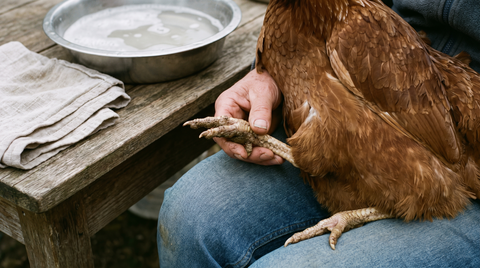
To check, part the feathers around the vent in good light and look closely at the skin and the base of the feather shafts. Run your fingers along the underside of a roost at night. If you find parasites, treat the entire flock, not just the obvious bird, and clean and treat the coop too. Our step-by-step guide on how to get rid of chicken mites and lice covers exactly how. Powders and sprays made for poultry are the usual tools, and you'll typically repeat treatment a couple of times to catch newly hatched parasites. A sand dust-bath, sometimes with food-grade diatomaceous earth, helps birds keep themselves in check. Because parasite products and dosing vary, I'd talk to your vet or a reputable supplier before choosing one.
Why is only one area of my hen bare?
When feathers are missing from one area rather than shed all over, the location tells the story: a bare back or saddle usually means rooster mating, a bald breast means a broody hen, and patches she can't reach point to feather pecking by flockmates. In these cases the feathers aren't shed at all, they're removed. And the pattern of where they're missing tells you a lot.
Feather pecking by flockmates shows up as bald patches in spots a bird can't reach herself, often the back, rump, or tail. It's more common in stressed, bored, or crowded flocks, and it can escalate, so it's worth taking seriously. If the skin gets raw or broken, other hens are drawn to peck more, and it can spiral.
Rooster mating is a classic, usually-harmless cause of a bare back or saddle area, most often in spring. The rooster's claws and beak wear and break the hen's back feathers as he treads her. These broken feathers usually won't grow back until her next molt. A properly fitted hen saddle (apron) can protect her skin in the meantime, though you should remove it during molt when the skin is tender.
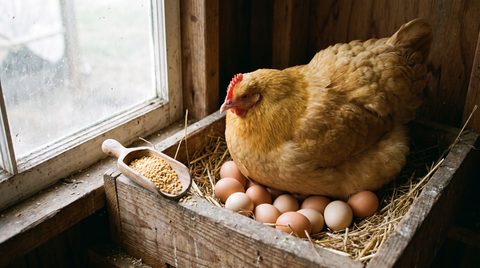
Broodiness creates a very specific bald spot on the breast. A hen sitting on eggs plucks her own breast feathers to form a "brood patch," bringing her body heat and a little moisture closer to the eggs. It's normal nesting behavior, and the feathers return when she molts after the chicks hatch or she gives up sitting.
If pecking or mating has left skin raw or broken, keeping that skin clean matters, because broken skin invites more pecking and possible infection. A gentle poultry-safe topical like our chicken wound spray can help you keep a minor raw patch clean while feathers regrow. To be honest with you, it's a supportive tool, not a cure for the underlying cause, so pair it with fixing the crowding, adding a saddle, or separating a persistent pecker. For deeper wounds and pecking injuries, our full guide on chicken first aid for wounds, pecking, and bumblefoot covers what to do step by step.
Can stress or diet make my chicken lose feathers?
Yes — stress can trigger an out-of-season "stress molt," and a diet low in protein or key amino acids can leave hens unable to grow good feathers and even prompt them to peck each other. These two background factors can both trigger feather loss and make everything else worse.
Stress can bring on a partial "stress molt" outside the normal fall window. Common stressors include sudden housing changes, extreme heat, predator scares, overcrowding, losing or adding flock members, and abrupt changes in light or routine. A broody hen coming off her nest often drops a flush of feathers as her hormones reset, which is a stress-related molt too. Reducing stress means steady routines, enough space, shade and water in heat, and a calm, predator-secure coop. Cold weather is its own stressor, and our guide on how to keep chickens healthy in winter covers keeping a flock comfortable through the hard months.
Nutrition matters because feathers are built almost entirely from protein. A diet short on protein, or on key amino acids like methionine, can leave hens unable to grow good feathers and can even push them toward pecking each other. A quality layer feed (commonly around 16 to 18 percent protein) is the foundation. During a molt, many keepers temporarily nudge protein higher, toward 18 to 20 percent, with a molt or grower feed or occasional protein-rich treats like scrambled eggs or mealworms, then return to normal feed once feathers fill in. Don't overdo treats, and always keep fresh water available.
How do I tell the causes apart at a glance?
Use the table below to narrow the cause from telltale signs — clean shed with pin feathers means molt, bugs and itching mean parasites, unreachable bald patches mean pecking, a bare saddle means a rooster, a bald breast means broodiness — then confirm with a close look at the skin. This is the part I'd pin inside the coop.
| Likely cause | Telltale signs | What to do |
|---|---|---|
| Normal molt | Clean shed, healthy pink skin, new pin feathers, often late summer/fall, laying slows | Boost protein toward 18-20%, reduce handling, be patient (4-12 weeks) |
| Mites or lice | Bugs or nits near vent, scabs, pale comb, itching, restless at night, weight loss | Treat the whole flock and coop with poultry-safe products; repeat; consult vet on choice |
| Feather pecking | Bald patches the bird can't reach (back, rump), sometimes raw skin, crowded/bored flock | Add space and enrichment, separate persistent peckers, protect raw skin |
| Rooster mating | Bare back or saddle area, broken feathers, often spring, rooster present | Fit a hen saddle (not during molt); feathers return at next molt |
| Broody hen | Bald breast patch, hen sitting tight on nest, fluffed and growly | Normal nesting; feathers regrow after she stops sitting |
| Stress or low protein | Partial out-of-season molt, dull feathers, after a scare/move/heat, poor diet | Reduce stressors, steady routine, ensure quality feed and fresh water |
What should I check coop-side?
Work through a quick checklist: inspect the skin and vent, look for new pin feathers, note where the feathers are missing, factor in season and recent changes, and review diet and the whole flock's behavior. Next time you spot feathers on the ground, run through this:
- Part the feathers and look at the skin: clean and pink (likely molt) or scabby, reddened, or buggy (likely parasites)?
- Look for new pin feathers coming in, the sign of a healthy molt.
- Check the vent and feather shafts closely for live mites, lice, or nits, and inspect the roosts at night.
- Note where the feathers are missing: breast (broody), back or saddle (rooster), spots she can't reach (pecking).
- Consider the season and recent changes: heat, a move, new birds, or a predator scare.
- Review the diet, especially protein, and confirm constant fresh water.
- Watch the whole flock for itching, pale combs, weight loss, or birds acting unwell.
When should I call a vet about feather loss?
Call a vet for open or bleeding wounds, scabby skin that won't heal, a heavy or spreading parasite load, pale combs with lethargy, ongoing weight loss, or feather loss alongside birds that aren't eating, drinking, or acting well. Most feather loss sorts itself out with patience, better nutrition, or parasite control. But please reach out to a veterinarian, ideally one who sees poultry, if you notice any of these: open or bleeding wounds or scabby skin that won't heal; a heavy or spreading parasite load you can't get ahead of; pale combs paired with lethargy; ongoing weight loss; feather loss alongside a bird that isn't eating or drinking; or sudden flock-wide feather loss with multiple birds acting sick. A vet can identify the exact parasite under a microscope, check for underlying disease, and build a flock-level plan. When something feels off and you can't explain it, trust that instinct and ask for help. It's the kindest thing you can do for your birds.
Frequently asked questions
Is it normal for my chicken to lose a lot of feathers at once?
Yes, during an annual molt many hens drop feathers fast, sometimes looking patchy or nearly bare for a week or two. As long as the skin underneath is clean and pink with new pin feathers pushing through, a heavy molt is usually normal. It typically wraps up in 4 to 12 weeks.
How can I tell molting from mites or lice?
Molt feathers fall out cleanly with no skin damage, and you'll see fresh pin feathers coming in. With mites or lice you'll often spot live bugs or tiny nits near the vent, scabby or reddened skin, a pale comb, and birds that seem itchy or restless at night. When in doubt, part the vent feathers and look closely in good light.
Do feathers grow back after molting?
Yes. Feathers lost in a normal molt are replaced as new pin feathers unfurl over the following weeks. Feathers that were broken or worn off by a rooster or by pecking, rather than shed, usually won't regrow until the bird's next molt, since the follicle has already finished that growth cycle.
Why is only my hen's back or rear bare?
A bare back or saddle area, especially in spring, often comes from a rooster's claws wearing feathers off during mating. A bald patch on the breast can mean a broody hen has plucked herself to warm her eggs. Targeted bald spots can also point to feather pecking by flockmates. Location is a big clue.
What should I feed a molting chicken?
Feathers are mostly protein, so a molt is demanding. Many keepers temporarily raise dietary protein toward 18 to 20 percent using a higher-protein feed or occasional protein treats like scrambled eggs or mealworms, then return to normal layer feed once feathers fill back in. Always provide constant fresh water.
When should I worry about feather loss?
Call a vet if you see open or bleeding wounds, scabby skin that won't heal, a heavy or spreading parasite load, pale combs with lethargy, ongoing weight loss, or feather loss paired with not eating or drinking. Sudden flock-wide loss with sick-acting birds also deserves professional attention.
How long does it take for feathers to grow back?
In a normal molt, most hens look respectable again within about 4 to 12 weeks, though a hard molt can take a little longer. Feathers broken off by a rooster or pecking won't regrow until her next annual molt, since that follicle has already finished its cycle. Steady nutrition and low stress help the new feathers come in strong.
Can chickens lose feathers in winter or cold weather?
Most hens finish their molt before deep cold sets in, but a late or stress-related molt can overlap with winter. A bird regrowing feathers in the cold needs extra protein and a draft-free, dry coop to stay comfortable. If only the feathers around the vent or neck look thin and the skin seems irritated, rule out mites before blaming the weather.
Will feather loss stop my hen from laying eggs?
Often, yes, at least for a while. Because feathers are roughly 85 percent protein, a molting hen's body redirects resources to regrowth and laying usually slows or pauses until she's done. This is normal and temporary, and most hens return to laying once their new feathers are in. If she stays bare and off-lay for many weeks, or seems unwell, check for parasites or other causes.
Is it cruel to handle or pick up a molting chicken?
New pin feathers have a blood supply and can be tender or even bleed if bumped, so a molting hen may dislike being held more than usual. It's kindest to limit handling during a heavy molt and be gentle when you do need to pick her up. There's no harm in leaving her be while she regrows, as long as she's eating, drinking, and acting normal otherwise.
Products mentioned in this guide

Sources & further reading
A note from Sarah: I'm a lifelong keeper, not a veterinarian. This guide shares what's worked for my own flock and is meant for general education - if a bird is seriously ill or injured, please call your vet. These statements have not been evaluated by the FDA.