Key takeaways
- Lice look like pale, rice-shaped crawlers with egg clusters glued to feather shafts; mites are tiny moving dots that can leave salt-and-pepper specks in the coop.
- Red (roost) mites hide in coop cracks by day and feed at night, so check birds after dark; northern fowl mites and lice live on the bird and concentrate around the vent.
- You must treat the bird AND the coop, then re-treat in about 7 days to catch newly hatched eggs that the first round misses.
- A deep dust bath of sand and food-grade diatomaceous earth, plus regular vent checks, is your best year-round prevention.
Quick answer: To get rid of chicken mites and lice naturally, first identify what you have (red mites hide in the coop and feed at night; northern fowl mites and lice live on the bird near the vent). Then treat the birds and the coop together — a sand-and-diatomaceous-earth dust bath, a thorough coop clean-out, and a repeat treatment about a week later to catch newly hatched eggs.
I've kept backyard hens my whole life, and external parasites are the one problem that finds every flock sooner or later. They hitch a ride on wild birds, in a bag of straw, or on a new hen you brought home. The good news: once you know what you're looking at, mites and lice are very manageable — and a lot of it comes down to old, simple habits my family has leaned on for four generations on our organic farm.
The biggest mistake I see is people spraying the bird, declaring victory, and missing the coop entirely — or skipping the second treatment a week later. Let's do it properly so they actually stay gone.
How do I tell chicken mites from lice?
Lice are pale, fast-moving, rice-shaped crawlers that live on the bird full-time and glue clusters of whitish eggs (nits) to the base of feather shafts. Mites are much tinier specks; some live on the bird, while red mites hide in the coop and only climb on at night to feed.
Part the feathers around the vent in good light. Lice are big enough to watch scurry away from the light — they're chewing insects that eat feathers and skin debris, not blood. Mites read as moving dots, and blood-feeding mites can leave reddish-brown flecks or a salt-and-pepper, ash-like residue on the skin, roosts, and around the vent.
The three you'll most likely meet
- Northern fowl mite — spends its whole life on the bird, so populations explode fast. Look for dark, dirty-looking feathers and reddish-brown crusting around the vent and tail.
- Red mite (roost mite) — hides in cracks, roost ends, and nest-box seams by day and feeds at night. You often find the mites, not on the bird, but in the coop as gray or red specks in the crevices.
- Lice — flesh-colored, rice-shaped, and visible. Their giveaway is those packed nit clusters cemented at the feather base near the vent.
Which parasite do I have? (identification & triage table)
Use this table to match what you're seeing to the likely culprit and the first move. When in doubt, treat as if you have both mites and lice — the bird-and-coop approach covers all of them.
| What you see | Likely culprit | Where to look | First move |
|---|---|---|---|
| Pale, rice-shaped crawlers; white egg clusters glued to feather shafts | Lice | On the bird, base of feathers near the vent | Treat bird; re-treat in ~7–10 days for hatched eggs |
| Tiny dark/reddish moving dots on skin; dirty crusty vent feathers | Northern fowl mite | On the bird, vent / tail / breast | Treat bird thoroughly; re-treat in ~7 days |
| Few parasites on bird by day, but gray/red specks in coop cracks; birds reluctant to roost | Red (roost) mite | In the coop — roost ends, nest boxes, crevices | Check birds at night; treat coop hard; re-treat every 4–7 days |
| Pale comb & wattles, weakness, drop in laying | Heavy blood-feeding mite load (anemia) | Comb, wattles, overall condition | Treat urgently; call a vet for a weak or collapsing bird |
| Itchy bites on your own arms after handling birds | Red mites biting people | Your skin after coop work | Clear the coop & birds; bites resolve once parasites are gone |
How do I check my chickens for mites and lice?
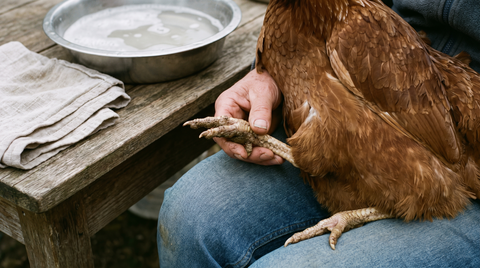
Pick up each bird and part the feathers right around the vent, where parasites concentrate — and for red mites, do it after dark, because that's when they climb onto the bird to feed.
The vent area, the fluffy feathers under the tail, and the skin near the breast are the hot spots. Spread the feathers down to the skin and look at the shafts and the skin itself. Nit clusters mean lice. Moving specks and reddish crusting mean mites.
The nighttime test for red mites
Red mites are the sneaky ones — a daytime check can come back clean while the coop is crawling at night. Wipe a white paper towel along the underside of the roost and into the joints after dark. If it comes away with red or brown streaks, you've got roost mites. You can also run a finger along the roost ends and nest-box seams and watch for tiny dots scattering. If your birds suddenly hate going into the coop at night, suspect red mites.
How do I treat the birds naturally?
Dust the bird directly and give the whole flock a deep dust bath of sand and food-grade diatomaceous earth (DE), working it down to the skin around the vent — then treat again in about a week.
A generous dust-bathing box is the workhorse of natural control. The classic mix is play sand with food-grade DE worked through it; as birds bathe, the fine dust dries out the waxy coating of any parasite it contacts. For an actively infested bird, you can also hand-dust gently into the vent and under-wing feathers, holding the bird so the powder reaches skin level. Wear a mask — you don't want to breathe the dust, and neither do they, so keep it to the feathers, not the air.
Be honest with yourself about DE's limits: it only works on parasites it physically touches and dries out, and it does nothing to eggs or to mites hiding in coop cracks. That's exactly why you re-treat about seven days later — to catch the next generation as it hatches, before it can breed again. For severe infestations, anemic birds, or a flock that isn't responding, an approved insecticide or a vet-prescribed product may be the kinder, faster choice; always follow the label's egg-withdrawal instructions.
Heavy mite and lice activity often leaves the vent skin raw, scabbed, or pecked. Once the parasites are knocked back, a poultry-safe topical like our chicken wound spray can soothe and protect that irritated skin while it heals — it treats the damage, not the bug, so pair it with real parasite control rather than using it alone.
Why do I have to treat the coop too?
Because red mites live in the coop, not on the bird — if you only treat the chickens, the coop reseeds the infestation within days. Roost mites can survive months off a host, so the housing has to be cleaned and treated alongside the flock.
Strip the coop down. Remove and compost or burn all bedding (loose feathers can carry nits too), then scrub and treat every roost end, nest box seam, crack, and crevice — those dark joints are exactly where red mites shelter by day. A good clean-out followed by dusting the crevices and bedding makes the coop hostile to the next wave.
Then mind the timing. Mite eggs keep hatching, so re-treat the coop on a tight cycle — roughly every four to seven days for an active red-mite problem — until your nighttime paper-towel test stays clean. Skipping that follow-up is the single most common reason an infestation roars back a fortnight later.
How do I keep mites and lice from coming back?
Give your birds a permanent, deep dust bath, check vents every few weeks, quarantine newcomers, and keep wild birds and rodents away from the coop.
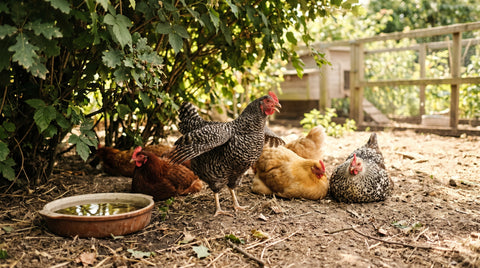
Chickens are wired to dust-bathe — it's their natural parasite control — so the kindest prevention is simply making that easy year-round.
- Keep a large, deep dust-bathing box of dry play sand with food-grade DE mixed in, topped up and dry.
- Do a hands-on vent check every two to four weeks, more often in warm weather.
- Quarantine and inspect every new bird for at least two weeks before it joins the flock.
- Clean the coop regularly and clear out loose feathers that can harbor hatching nits.
- Seal cracks and seams where red mites hide, and keep nest boxes clean and dry.
- Discourage wild birds and rodents around the run — they're a common way parasites arrive.
- Keep the whole flock in good condition; a healthy, well-fed bird shrugs off a light load far better.
External parasites are a separate problem from internal worms, but a strong, well-supported flock copes with both far better. If you're shoring up overall resilience, our herbal natural chicken dewormer is built for the internal side of parasite care — it targets worms, not mites and lice, so think of it as a companion to the dust-bath-and-coop routine here, not a substitute. For the internal picture, it's worth learning the signs of worms in chickens and how to deworm chickens naturally. And because parasites are a leading cause of feather damage, my guide to why your chicken is losing feathers walks through the other culprits to rule out, and the molting and feather regrowth guide covers helping those feathers come back in once the parasites are gone.
When should I call a vet?
Call a vet if a bird is weak, pale-combed, or collapsing from suspected anemia, if the flock isn't improving after proper bird-and-coop treatment, or before using any medicated product on laying hens so you get the egg-withdrawal right.
I'm a lifelong keeper, not a veterinarian, and blood-feeding mites can genuinely endanger a bird. A very pale comb and wattles, sudden weakness, or a bird going downhill fast are signs of dangerous anemia that needs hands-on help. A vet can also confirm exactly which parasite you're fighting, prescribe products cleared for layers, and advise on withdrawal periods so your eggs stay safe to eat.
Frequently asked questions
Can chicken mites and lice live on humans?
Chicken lice are host-specific and won't set up home on you. Some mites, especially red mites, will bite people and cause itchy welts if you handle infested birds or work in a heavily infested coop, but they can't complete their life cycle on humans and will die off once the birds and coop are cleared.
How often should I check my chickens for mites and lice?
Do a hands-on vent check every two to four weeks, and always quarantine and inspect any new bird before it joins the flock. Check more often in warm weather and after wild birds or rodents have been around the coop, since those are common ways parasites arrive.
Does diatomaceous earth really kill mites and lice?
Food-grade diatomaceous earth can help by drying out the waxy coating of parasites it directly touches, which is why it works well in a dust bath. It is not a magic cure on its own — it does nothing to eggs or to mites hiding in coop cracks, so use it as part of a plan that includes treating the bird and cleaning the coop.
Why do I need to treat my chickens twice?
Most treatments kill crawling mites and lice but not their eggs, and the eggs keep hatching for days afterward. Treating again about a week later catches the newly hatched parasites before they can lay their own eggs and restart the cycle.
Will mites and lice make my hens stop laying?
They can. Constant irritation, lost sleep and blood loss stress a hen, and a heavy infestation often causes a noticeable drop in eggs. Clearing the parasites usually brings laying back up once the birds recover.
Are mite and lice treatments safe around eggs I plan to eat?
It depends entirely on the product. Many insecticides have an egg-withdrawal period during which you must discard eggs, so always read the label and follow it exactly. Dust baths with plain sand and food-grade diatomaceous earth don't carry that concern. When in doubt, ask your vet which product is cleared for laying hens.
Where do chicken mites and lice come from in the first place?
They usually arrive on wild birds, rodents, or a newly bought hen, and they can also hitch in on used equipment or bags of straw and bedding. That's why quarantining new birds and discouraging wild birds and rodents around the run matters so much. Even a spotless coop can get an infestation from an outside source, so it's not a sign you've done anything wrong.
How long does it take to get rid of mites and lice?
With consistent bird-and-coop treatment and a repeat round about a week later, most infestations clear in roughly two to four weeks. Stubborn red-mite problems in an older or cracked coop can take longer because the mites shelter in crevices. Keep going with the treat-and-retreat cycle until your nighttime paper-towel test stays clean.
Can mites and lice kill a chicken?
A light load mainly causes irritation, but a heavy blood-feeding mite infestation can cause dangerous anemia, especially in young, old, or already-weak birds, and that can be fatal if left unchecked. Watch for a very pale comb and wattles, weakness, or a bird going downhill, and treat urgently. Call a vet for any bird that seems to be collapsing.
Is apple cider vinegar or garlic a good natural mite treatment?
Some keepers add a little apple cider vinegar to water or feed garlic for general flock condition, but there's no solid evidence either one reliably kills or repels mites and lice. Don't rely on them as your main treatment. The methods that actually work are a sand-and-DE dust bath, treating the coop, and re-treating to break the egg cycle.
Products mentioned in this guide

Sources & further reading
A note from Sarah: I'm a lifelong keeper, not a veterinarian. This guide shares what's worked for my own flock and is meant for general education - if a bird is seriously ill or injured, please call your vet. These statements have not been evaluated by the FDA.