Key takeaways
- A broody hen sits the nest all day, puffs up, and stops laying eggs — and a long broody spell can cost her weight and condition.
- Always start with the gentlest method that works: repeatedly lifting her off the nest and removing eggs breaks many hens within a few days.
- For a stubborn or repeat broody, a wire-bottomed broody breaker crate cools her brood patch and usually resets her in 3–5 days.
- If you actually want chicks and have fertile eggs, it can be kinder to simply let a calm, committed hen hatch them out.
Quick answer: To break a broody hen, start with the gentlest method that works: lift her off the nest and remove the eggs several times a day. If she keeps returning, block the nest box, and for a stubborn hen use a wire-bottomed "broody breaker" crate that cools her underside for 3–5 days. Always leave food, water, and shade.
If one of your hens has planted herself in a nesting box, puffed up like a feather duster, and growls every time you reach under her, congratulations — she's gone broody. I've been keeping backyard chickens since I was a little girl on my family's organic farm, and broodiness is one of those rites of passage every keeper eventually meets. It's natural, it's harmless in short bursts, but a hen who sits for weeks stops laying and can run herself thin. The good news: you can break her of it humanely, and you've got options ranging from very gentle to very effective.
Let me walk you through how to recognize a true broody, why it's worth doing something about, and five humane methods ranked from the kindest first step to the reliable wire crate.
How do I know if my hen is actually broody?
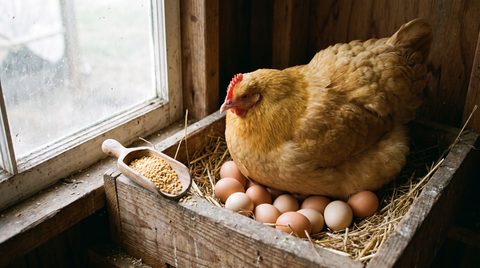
A broody hen refuses to leave the nest box, sits flattened and puffed up, and won't go roost with the flock at night. If you lift her off and she marches straight back, she's broody — not just laying.
A hen visiting the nest to lay an egg is in and out within an hour. A broody hen, by contrast, becomes a permanent fixture. Watch for these signs:
- She sits in the nest box all day and stays there at night instead of roosting.
- She fluffs up, flattens herself wide over the eggs, and may growl, screech, or peck when you approach.
- She plucks feathers from her chest and belly to make a bare "brood patch" — bare skin transfers heat to eggs better.
- She leaves the nest only briefly once a day, often producing one large, foul-smelling "broody dropping."
- She hoards eggs, rolling other hens' eggs under herself, and she has stopped laying her own.
The simplest test: gently lift her out of the box and set her down with the flock. A hen finished laying will wander off to eat and scratch. A broody hen will make a beeline back to the nest, often grumbling the whole way.
Why does it matter if I just leave her broody?
A broody hen stops laying eggs and eats and drinks very little, so a spell that drags on for weeks can leave her thin, dehydrated, and run-down. Breaking her early protects both her body condition and your egg supply.
Broodiness is driven by a hormone called prolactin — the same family of hormones that prepares mammals to nurse. When prolactin rises, it suppresses the signals that make ovaries produce eggs, which is why a broody hen simply stops laying. That hormonal state also kills her appetite. Research on broody hens shows a significant drop in feed intake compared to when they're laying, and a hen who sits for the full three-week incubation cycle can lose noticeable weight and muscle.
On top of that, a hen glued to the nest is more prone to mites and lice (she's not dust-bathing) and to messing the nest box, which fouls eggs your other hens are trying to lay. None of this is an emergency in the first day or two — but it's exactly why most keepers choose to act rather than wait three weeks. If you've noticed your flock's egg numbers dip, broodiness is one common culprit; I cover the others in why chickens stop laying eggs.
What are the 5 humane ways to break a broody hen?
Work from gentlest to most assertive: (1) repeated nest removal, (2) remove eggs and bedding, (3) block the nest box, (4) cool her underside, and (5) the wire broody breaker crate. Most hens break on one of the first three; the crate is your reliable finisher.
Always try the kindest method that has a real chance of working before escalating. Here's the ladder.
1. Repeated nest removal (the gentlest)
Several times a day, lift her out of the box and set her down by the food and water. Many hens simply lose the thread when they keep getting interrupted, especially if you catch the broodiness in its first day or two. This is low-stress and free — but it takes diligence, and a committed hen will outlast a half-hearted effort.
2. Remove the eggs and the bedding
Collect eggs promptly so nothing accumulates under her, and once she's off, pull the bedding out of that box. A bare, hard, comfortless box is far less inviting than a cozy nest of straw. Combine this with method 1 for a stronger nudge.
3. Block the nest box
If she keeps reclaiming the same box, close it off — a board, a bin, or a closed lid — so she physically can't get back in. Make sure your other layers still have at least one open box elsewhere. Removing the destination often resets a moderately stubborn hen within a few days.
4. Cool her underside
Broodiness is partly maintained by the warmth of her brood patch, so cooling it helps lower those hormones. Some keepers tuck a frozen water bottle or cool gel pack under her, or set her on a bag of frozen peas for a spell. Never dunk a hen in cold water to the point of chilling or stressing her — gentle, brief cooling is the goal, not a shock.
5. The wire broody breaker crate (the reliable finisher)
For a stubborn or repeat-offender ("serial") broody, this is the gold standard. Put her in a wire-bottomed cage — a dog crate with a wire floor works well — raised up on bricks so air circulates underneath her. With no bedding and cool air moving under her bare brood patch, she can't keep the patch warm, and her hormones reset. Keep food and water in the crate at all times, and place it somewhere shaded and safe. Most hens break in 3–5 days; the University of Kentucky Extension and Cornell small-flock guidance describe wire-floored crating for several days as a standard, humane reset. When she stands in the crate looking bored and stops trying to nest-sit, she's done — return her to the flock.
Which broody-breaking method should I use?
Match the method to how stubborn she is and how much time you have. Start gentle; escalate to the wire crate only if she keeps returning to the nest.
| Method | How it works | Typical time to break | Effort | Best for |
|---|---|---|---|---|
| 1. Repeated nest removal | Lift her off and set her with the flock several times a day | 2–4 days (if it works) | High — many trips daily | Caught-early, mildly broody hens |
| 2. Remove eggs & bedding | No eggs to sit on; bare, uncomfortable box | 3–5 days | Low | Pairing with other methods |
| 3. Block the nest box | She physically can't return to her chosen nest | 3–5 days | Low–medium | Hens fixated on one box |
| 4. Cool her underside | Brief cooling of the warm brood patch lowers hormones | 3–5 days (as a helper) | Medium | Supplementing other methods |
| 5. Wire broody breaker crate | Cool air under a wire floor resets the brood patch | 3–5 days (up to ~7) | Medium (daily checks) | Stubborn or serial broody hens |
My honest advice: try methods 1–3 for a couple of days. If she's still flat in the nest, move straight to the crate. Dithering for two weeks is harder on the hen than a clean three-day reset.
When should I just let her hatch instead of breaking her?
If you actually want chicks, have fertile eggs (or can get some), and the hen is calm and committed, letting her sit can be the kindest, easiest path. A determined broody is already doing the job for free.
Breaking a hen isn't always the right call. A broody hen will incubate eggs for about 21 days and then raise the chicks herself — no incubator, no brooder lamp, no fuss. If you'd welcome a few more birds and have access to fertile eggs, set her up in a quiet, predator-safe spot with her own food and water and let nature run.
A few cautions before you commit: make sure local rules and your space allow more birds (and remember roughly half of any hatch will be cockerels you'll later need to integrate or rehome carefully), confirm your eggs are fertile, and pick a hen with a steady temperament. If you do go this route — or end up raising chicks any other way — my baby chick brooder guide covers what those new arrivals need. And if you're still building your flock from the ground up, start with the backyard chickens beginner's guide.
Which chicken breeds go broody the most?
Broodiness is largely inherited, so it clusters in certain breeds. Silkies, Cochins, Orpingtons, Brahmas, Australorps, Sussex, and most bantams go broody readily, while high-production layers like Leghorns and hybrid Sex Links rarely do.
If you keep one of the classic mothering breeds, expect to repeat this dance every season — it's in their genes. If you specifically don't want broodiness, lean toward production layers.
- Frequently broody: Silkies (the gold standard for setting), Cochins, Buff Orpingtons, Brahmas, Australorps, Sussex, and most bantam breeds.
- Rarely broody: Leghorns, Anconas, Hamburgs, and most commercial brown-egg hybrids and Sex Links, in whom broodiness was largely bred out to maximize laying.
Knowing your breed's tendency helps you respond calmly. A broody Silkie isn't sick — she's doing exactly what generations of selection built her to do.
How can I prevent a hen from going broody?
You can't eliminate broodiness in a mothering breed, but you can reduce triggers: collect eggs daily, keep nest boxes from becoming hoarding spots, and act at the first sign rather than waiting.
A few habits cut down on broody episodes:
- Gather eggs at least once a day so a clutch never accumulates in a box.
- Discourage hens from sleeping in nest boxes — that overnight nesting can tip into broodiness.
- Watch closely in warm weather, when broodiness peaks, and act within the first day or two.
- If you've had chicks visible nearby, know that the sight of them can set a susceptible hen off.
Prevention won't make a Silkie stop being a Silkie — but it keeps episodes shorter and rarer.
When should I call a vet?
Broodiness itself isn't a medical emergency, but call a vet if a hen has been off her feed and on the nest for weeks and is visibly thin or weak, or if you suspect she's egg-bound or ill rather than truly broody.
I'm a lifelong keeper, not a veterinarian, so when something crosses from "normal hen behavior" into a health concern, get a qualified poultry vet involved. Reach out if:
- She's been broody for weeks and is now noticeably underweight, lethargic, or dehydrated.
- She strains, stands penguin-style, or sits puffed but isn't actually nesting — possible signs of being egg-bound, which is a different and time-sensitive problem.
- You see pale comb, labored breathing, swelling, foul-smelling discharge, or other signs of illness.
- A hen who has hatched chicks suddenly stops eating or seems unwell.
When in doubt, a quick call to an avian or poultry vet beats guessing. A healthy broody just needs breaking; a sick hen needs care.
Frequently asked questions
How long does it take to break a broody hen?
It depends on the method and the hen. Repeatedly lifting her off the nest may work in 2–4 days, while a wire-bottomed broody breaker crate usually resets a stubborn hen in 3–5 days, sometimes up to a week for a serial broody. The earlier you start, the faster it tends to go.
Will a broody hen eventually stop on her own?
Most will, but it can take three weeks or more — about the length of a natural incubation cycle. During that time she barely eats or drinks and can lose noticeable weight and condition, so most keepers choose to break her rather than wait it out.
Is it cruel to break a broody hen?
No — done humanely it's actually kinder than letting her sit for weeks losing weight on eggs that will never hatch. The methods here simply cool her down and remove the nest cues. The wire broody breaker is an accepted welfare practice as long as she always has food, water, and shade.
Can a broody hen die from being broody?
It's uncommon, but a hen who sits for many weeks can become dangerously thin, dehydrated, or prone to mites and illness because she rarely leaves the nest. That risk to her body condition is exactly why breaking a long broody spell matters.
Which chicken breeds go broody the most?
Silkies are the classic broody breed, followed by Cochins, Orpingtons, Brahmas, Australorps, Sussex, and most bantams. High-production layers like Leghorns, Sex Links, and most hybrid brown-egg layers rarely go broody because broodiness was bred out of them.
Does removing eggs alone stop a broody hen?
Sometimes, but usually not by itself. Many broody hens will sit on an empty nest — or steal other hens' eggs — out of pure hormones. Removing eggs works best combined with lifting her off the nest several times a day, or blocking the nest box entirely.
Can I move a broody hen and her eggs to a new nest?
You can, but do it carefully — some hens abandon the clutch if moved. If you want her to hatch in a safer spot, move her at night to a quiet, enclosed broody pen with her own food and water, and ideally keep the same eggs and nesting material so it still feels like her nest. Give her a day to settle and check that she resettles on the eggs rather than pacing.
Do I still need to break a broody hen in winter?
Yes, and arguably it's more urgent. A hen sitting a cold, empty nest for weeks still stops eating well and loses condition, which is harder on her in winter when she needs reserves to stay warm. Unless you genuinely want a winter hatch with fertile eggs, it's kinder to break her promptly so she returns to eating, dust-bathing, and roosting with the flock.
Why is my hen broody when I don't have a rooster?
Broodiness is hormonal and has nothing to do with whether the eggs are fertile — a hen with no rooster will still go broody and sit faithfully on infertile eggs that will never hatch. That's actually a good reason to break her: she could sit for weeks on a clutch with no possible payoff. If you do want chicks, you'd need to source fertile eggs to slip under her.
How do I put a hen back with the flock after breaking her broodiness?
A hen that's been crated or separated for a few days can briefly slip down the pecking order, so reintroduce her in the evening when birds are calm and watch for squabbling the next morning. Most hens slot right back in within a day. If pecking turns rough or draws blood, our guide on the chicken pecking order and how to stop bullying walks through calming a flare-up.
Sources & further reading
A note from Sarah: I'm a lifelong keeper, not a veterinarian. This guide shares what's worked for my own flock and is meant for general education - if a bird is seriously ill or injured, please call your vet. These statements have not been evaluated by the FDA.